
Apostille from any country
Every migrant faces difficulties with document verification: diplomas, criminal record certificates, marriage certificates, and other papers often require an apostille or consular legalization. In this section we present partners who assist with document processing between different countries. In the city chat you can also get advice on whom to contact.
Russia ↔ USA
- Russia: Recognizes Apostille since 1992-05-31
- USA: Recognizes Apostille since 1981-10-15
Our partners — Goroda Perevodov Inc.
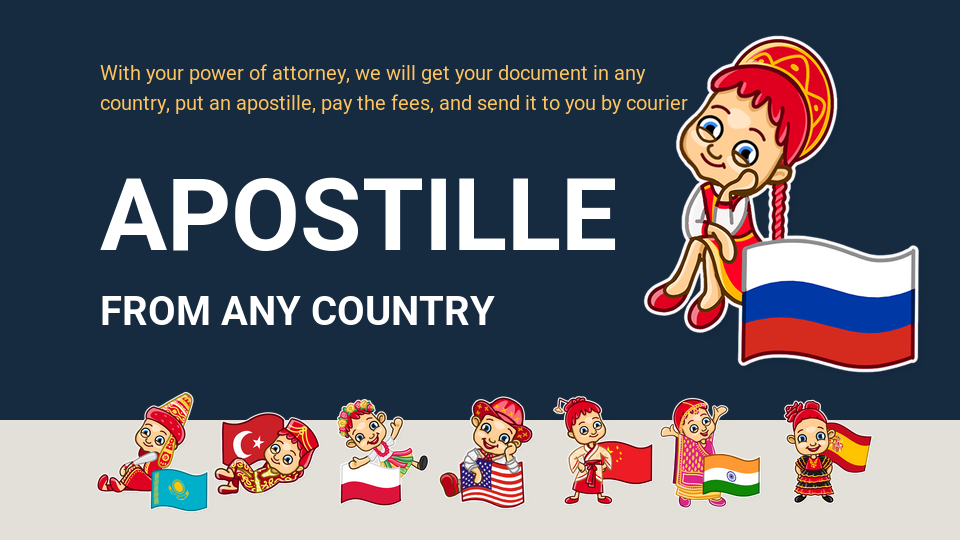
Получим ваши документы в таких странах, как
 Kazakhstan ↔ Russia
 Turkey ↔ Russia
 Poland ↔ Russia
 USA ↔ Russia
 China ↔ Russia
 India ↔ Russia
 Spain ↔ Russia
и любые другие страны
Обращайтесь:
What is an Apostille?
In 1961, many countries (though not all) decided to simplify the process of legalizing documents and came up with the apostille. It’s a square stamp, 10 by 10 centimeters. If this stamp is placed on a document in one country, another country is obliged to recognize it as legalized.
An apostille is valid only if it is recognized by both countries — the country where the document was issued and the country where it will be used. If at least one of the two countries has not joined the Hague Convention and therefore does not recognize the apostille, the document must undergo consular legalization through the Ministry of Foreign Affairs and the embassy or consulate of the destination country.
Remember! An apostille must be obtained only in the country where the document was issued, from that country’s competent authorities.
Some countries have agreements under which documents are recognized without an apostille and without consular legalization. Examples include the European Union, Russia ↔ Belarus, Kazakhstan ↔ Kyrgyzstan, and the MERCOSUR countries (for example, Argentina ↔ Uruguay), among others.
An apostille can only be applied to official (public) documents, that is, documents issued by state authorities, not by private companies. Check whose stamp is on your document — a government authority or a commercial organization. For commercial documents, an additional procedure is usually required: they are first certified by chambers of commerce or by notaries, and then an apostille or consular legalization may be applied.